



When Management Incentives Fall Out of Alignment: The Difference in Correlation Between Key Talent and Talent in General
In incentive plans for managers and staff (employees who work outside line functions, such as sales), one of the central objectives is to align compensation with organizational results and reward employees’ contributions to those results.
For the purposes of this brief article, we distinguish between talent in general and key talent. Key talent refers to employees who: 1) deliver outstanding results through high performance and have a clear, measurable impact on the company’s overall results; and 2) hold positions across the organization in which they can have that impact.
When an incentive plan is limited to key talent, the correlation between employee performance and the organization’s overall results is high—and stronger than that for talent in general. From the shareholders’ perspective, this establishes a clear link between what is achieved and what is paid.
A Monte Carlo simulation (using randomly generated values for the plan’s variables), based on a conventional model for these plans (overall company indicators plus weighted functional indicators), illustrates the difference:
Relationship Between Individual Results and Company Results
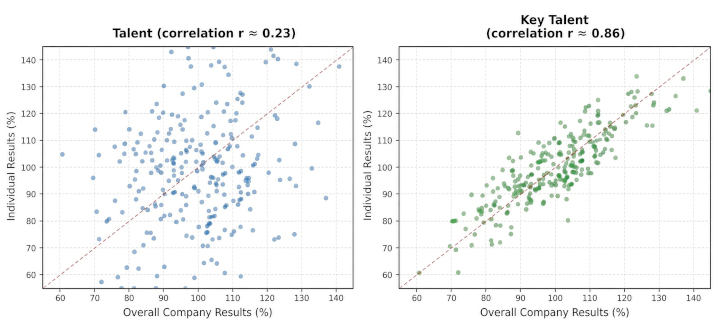
The chart on the left shows an example of a plan for talent in general. The points are widely scattered: the correlation between individual results and company results is weak (r ≈ 0.23). In the chart on the right (key talent), the points cluster more closely around the regression line (r ≈ 0.86).
This does not necessarily mean that incentive plans should be limited to key talent. In practice, these plans can—and in most cases should, for various reasons—cover the entire organization to mobilize collective effort, among other objectives. The condition is that the indicators, both for key talent and for talent in general, are designed to ensure a close link between individual or functional results and company results. By virtue of their positions and performance, key talent always shows a stronger correlation with overall company results (provided the incentive is well designed and governed). What distinguishes a good design is its ability to align talent in general as well, preventing the incentive from becoming a variable payment with little connection to the results achieved.
Note: The charts are based on a Monte Carlo simulation (250 scenarios) in which overall company results fluctuate around 100%. Individual results are generated with varying degrees of dependence on overall company results, depending on whether the simulation represents key talent or talent in general.