



Grow When the Region Does Not Grow
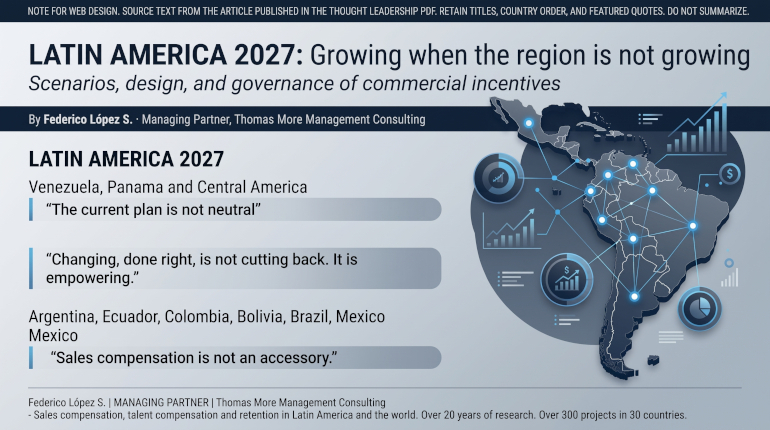
LATIN AMERICA 2027
Scenarios, design and governance of sales incentives
By Federico López S. · Managing Partner, Thomas More Management Consulting
Almost every forecast agrees: in 2027 Latin America will grow below the world average. The IMF, World Bank, OECD and ECLAC consensus places global growth near 3% and the region in a range of 2.5% to 2.7%. The decimal can be debated. The diagnosis cannot: the macro is not enough.
That average is dragged down mainly by Brazil and Mexico — about 60% of regional GDP. Above it sit, among others, Venezuela, Paraguay, Argentina, Peru and much of Central America. The detail is not in the bar chart. It is in the scenario behind each country and in what that scenario does to the incentive plan.
Country switches — what the scenario does to the plan
Venezuela
Recovery with dual exchange rates or a formal anchor (dollarization / currency board). These are not nuances. They change how selling works. Designing for a single path leaves the other without rules. In the transition, inflation does not fall overnight: the plan must work in both worlds — and, above all, in the passage from one to the other.
Panama and Central America
Here the 2.5% does not apply. The risk is not stagnation; it is waste. A rigid plan in a market that does move leaves money on the table. Design must follow the channel, nearshoring and regional accounts. Governance cannot treat Costa Rica, Guatemala and Panama as the same board.
Argentina
The switches are politics (an election year) and the dollar. If devaluation stays contained and inflation falls below 20%, growth can approach ~3.7%. If reserves do not hold, closer to 2.5%. In both cases there is growth. What there cannot be is a quota methodology that cannot be recalibrated intra-year, and a design that was not conceived for growth.
Ecuador
Near the average, driven by non-oil sectors: consumption, agri-exports, mining. Every plan change hits there. If El Niño appears, the commercial effect can be mitigated only if the plan already contemplates that scenario in the design.
Colombia
Credit, fiscal accounts and climate. The consumption — partly public — that supported 2026 must give way to private investment. Inflation still above 3%, BanRep near 12% and a demanding fiscal gap. The plan has to sell without the broad backing of credit: flexible quotas, tightly controlled governance.
Bolivia
The change has already happened: floating, implicit devaluation on the order of 30% and convergence of the parallel rate. Volume must be separated from value, margins protected, and quotas and territories rebuilt. Any target set on 6.96 pesos is already behind us.
Brazil
A hangover year: Selic still high, weaker post-election fiscal impulse, minimal devaluation. The switches are not the exchange rate; they are interest rates + fiscal policy. A plan financed by volume breaks if credit becomes more expensive. Tables, metrics and payment form must be redesigned, and the plan left ready if fiscal tightening hits.
Mexico
The base (~1.8%) is low because uncertainty with the United States and USMCA holds back investment. There is exports and consumption; there are not plants at the pace expected from nearshoring. Be ready for the base case and for the scenario in which the trade relationship clears. If it does not, incremental growth comes only from a superior performance design and agile governance.
The current plan is not neutral
Companies need to grow. The region, in the base scenario, does not guarantee it. That is why the incentive plan is not an appendix or something to “let run” for another year. It is the lever that turns a 2.5% regional figure into a different commercial result.
When the exchange rate, credit, fiscal policy or investment change, the design changes, the governance of the plan changes — or both. If they do not change, the plan in force does not stay still: either it fails to capture a large part of the upside, or it pushes in the wrong direction.
Changing, done well, is not cutting. It is amplifying. In a region where variable pay for sales forces is around 1.5% to 2% of revenue — on the order of US$50 billion a year — that decision does not admit improvisation.
Plans can be built with corporate consistency across the region. That consistency does not mean an identical plan in every country: it is a common framework of principles that still lets each market address its own switch and, therefore, raise its effectiveness.
Incentives are not everything that moves a sale. Product, price, channel, coverage and execution also weigh. A well-designed plan does not replace those decisions; it avoids working against them and can amplify them. The evidence of more than 20 years is clear.
Sales compensation is not an accessory. Well designed, governed and flexible in the face of each market’s real switch, it produces growth that the macroeconomy, alone, will not describe. Poorly designed and governed, it produces exactly the result no one wants to sign: growing at the region’s pace — or falling below it.